
How to Select the Right Inverter Pool Pump: Power, Flow, and Head Explained
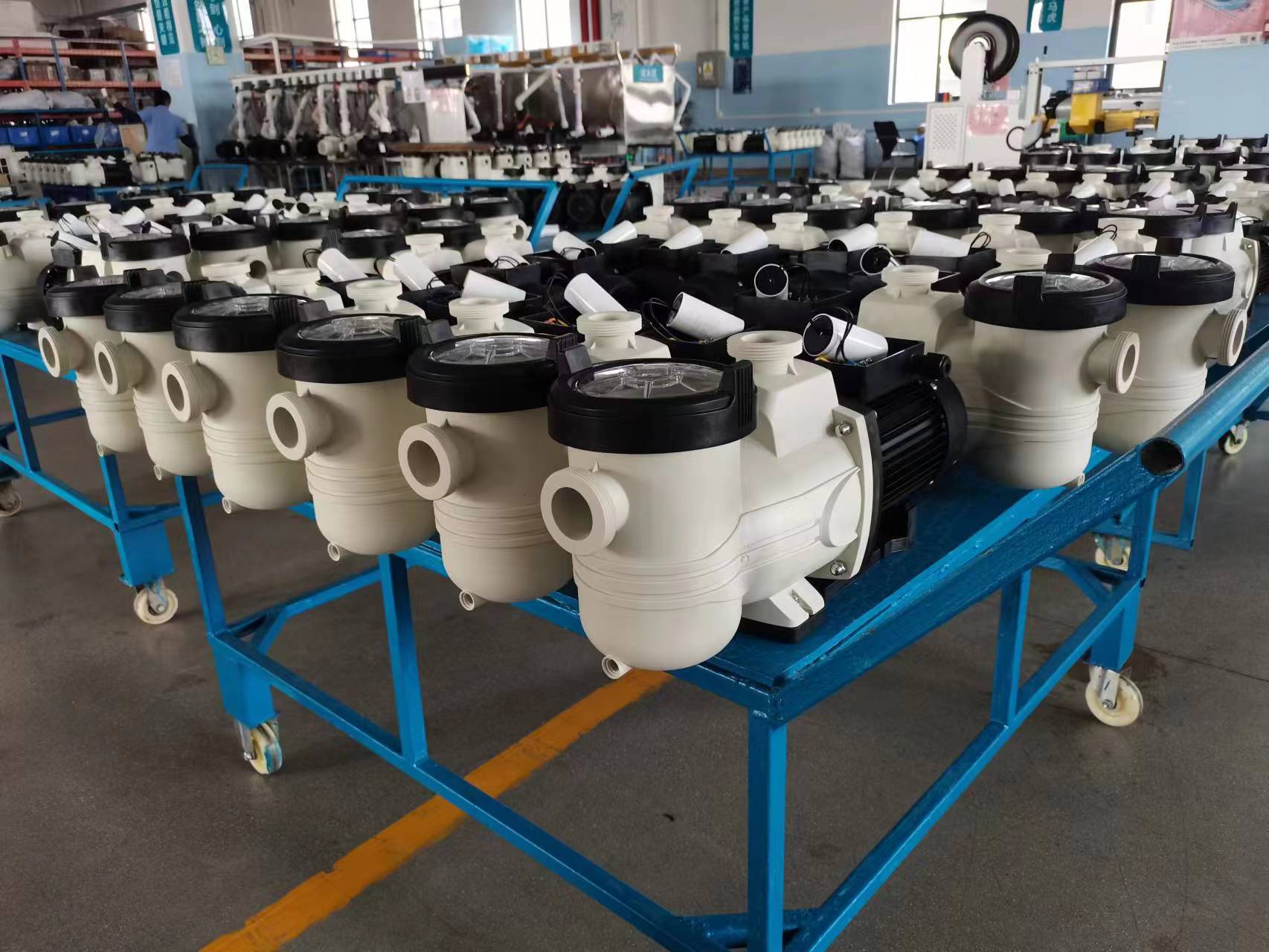
Introduction: Three Parameters Decide Whether an Inverter Pump Works
An inverter pool pump is a swimming pool circulation pump whose motor speed is controlled electronically instead of running at one fixed speed. Because speed can be reduced, the pump can match a pool's actual circulation demand for most of the day rather than operating at full output from morning to night.
Two inverter pumps can look almost identical on a specification sheet and still behave completely differently in the same pool, because real performance is decided by three parameters: output power, maximum flow rate, and maximum head. This guide explains what each parameter measures, how they interact, and how to match them to a residential pool. The LASWIM WL-ESP and WL-HV2100-200 inverter pool pump series are used throughout as working reference points.
For most residential pools the useful envelope is compact. Output power runs from 0.33 HP to 1.2 HP, maximum flow rate from 11 to 19 m³/h, and maximum head from 9 metres upward, with a variable speed range of 1000 to 3200 RPM. A pump inside that envelope can run slowly for daily filtration and then increase speed for backwashing, heating or heavy bather loads. What changes from project to project is not the envelope itself, but where inside it the duty point falls.
Why Pool Pump Selection Goes Wrong More Often Than Pump Hardware
Most circulation problems on residential pools trace back to selection rather than to the pump itself. Three patterns repeat.
- Sizing by pool volume alone. Volume tells you how much water has to be circulated each day. It says nothing about whether a pump can push that water through a filter, a heat exchanger, a salt cell and a run of pipework.
- Reading maximum flow as installed flow. A pump's maximum flow rate is quoted at its best operating point. Once the pump works against the resistance of a real installation, the flow it delivers is lower than the catalogue figure.
- Committing to a fixed speed. A single-speed pump has to satisfy the heaviest duty the pool will ever need, and it then runs at that duty continuously. Inverter control exists precisely because the heaviest duty occurs only a few hours a week.
The consequence of a misselected pump is rarely a dramatic failure. It is a pool that circulates less than assumed, a filter working outside its design flow, a heat pump that cannot reach temperature, and an electricity bill that reflects full-load operation for filtration that needed a fraction of it.
Industry Background: A Larger Installed Base, More Hydraulic Resistance
Pool equipment is a growing global category, and every addition to a pool system changes the load the circulation pump has to carry. The global swimming pool equipment market was estimated at USD 14.22 billion in 2025 and is projected to reach USD 21.33 billion by 2033, according to Market Research Future. China was the leading exporter of sports and pool equipment in 2024, with a trade value of approximately USD 3.77 billion, according to the Observatory of Economic Complexity.
Two components in particular are being added to residential pools in volume, and both sit downstream of the pump. The global pool heat pump market was valued at USD 5.09 billion in 2024, with North America holding a 34% share, according to Straits Research. The salt chlorine generator market for swimming pools was valued at USD 1.45 billion in 2024, with approximately 58% of new suburban residential pools opting for saltwater systems, according to Arizton Advisory & Intelligence.
From a pump selection standpoint, that matters for a simple reason: heat exchangers and electrolytic cells are additional resistance in the circuit, and a saltwater pool operates the pump in continuous salt exposure. A pump chosen only against pool volume, without recalculating head, will be undersized for the system it is actually installed in.
Safety expectations are moving in the same direction. Electric pumps for household use are covered by IEC 60335-2-41:2024, the safety standard published by the International Electrotechnical Commission, which sets out requirements for pumps handling liquids in domestic installations.
The Three Core Selection Parameters, Explained
1. Output Power — the Ceiling of the Performance Curve
Output power, expressed in horsepower or kilowatts, defines the upper limit of a pump's performance curve: the highest combination of flow and head the motor can sustain. It does not tell you the flow you will obtain at your installed head. That requires reading the curve at your duty point.
The LASWIM WL-ESP and WL-HV2100-200 inverter pump series cover an output power range from 0.33 HP to 1.2 HP. Choosing inside that range is a question of duty rather than prestige. The correct power is the lowest one that still delivers the required flow against your system's total head at the speed you plan to run.
Power also determines energy behaviour. On LASWIM's residential inverter pump platform, variable speed control combined with an IE4 high-efficiency motor reduces energy consumption by up to 90% compared with traditional single-speed pumps, with annual energy savings of up to 12,614 kWh based on a 2 HP continuous operation reference. Total ownership cost is reduced by approximately 30–50% over 3 to 5 years.
2. Maximum Flow Rate — Turnover Capacity and System Compatibility
Maximum flow rate, in cubic metres per hour, is the volume of water the pump can move in one hour at its best operating point. It sets the ceiling for how quickly the pool volume can be circulated, and it has to be compatible with everything else in the circuit.
The WL-ESP and WL-HV2100-200 series reach maximum flow rates of 11 to 19 m³/h. Two checks matter when you place a pump inside that band:
- Compatibility with filtration. Flow above the filter's rated capacity pushes media or cartridges beyond design conditions, while flow that is too low leaves the pool under-circulated.
- Compatibility with heat and disinfection equipment. Heat exchangers, salt cells and UV or AOP units each have their own preferred flow window, and the pump has to satisfy all of them at the same time.
Where a pool needs more capacity than the residential band provides, LASWIM's larger variable-speed models extend the range to 31–40 m³/h maximum flow with 16.9–20 m maximum head and input power options of 1000 W, 1300 W or 1650 W, which places them in medium-size commercial territory.
3. Maximum Head — the Resistance the Pump Can Overcome
Head, measured in metres, describes how much resistance a pump can push water against. Total head in a real installation has three parts: static lift (the vertical difference between water level and the points the water must reach), friction loss (pipe length, bends, valves, fittings), and equipment resistance (filter, heat exchanger, salt cell, heating circuit).
The WL-ESP and WL-HV2100-200 series are rated for a maximum head of 9 metres or more, which covers typical residential layouts where the equipment pad sits close to the pool and the pipe run is moderate. Two practical rules follow from how head behaves:
- Maximum head is a hard boundary. If the total head of your system exceeds the pump's maximum head, the pump cannot establish circulation at all and flow collapses toward zero.
- Head rises as flow rises. Running a variable-speed pump at a lower speed reduces flow and head together, which is why low-speed filtration remains effective without straining the pump.
Installation limits belong to the same calculation. LASWIM's residential inverter pump platform is designed for self-priming up to 3 metres, a maximum working pressure of 3.5 bar, an operating liquid temperature of 5–50 °C and a 63 mm (2") connection size — all of which should be checked against your actual pipework before ordering.
Behind the Three Parameters: Speed Range and Protection
The WL-ESP and WL-HV2100-200 series operate across a variable speed range of 1000 to 3200 RPM. The low end is the daily filtration setting; the upper end is reserved for backwashing, vacuuming, heating start-up and periods of heavy use. Variable-speed operation also reduces hydraulic shock and extends component life. LASWIM's residential inverter pumps require approximately 30–40% less maintenance than standard pumps, with built-in dry-run protection, temperature protection and pressure monitoring reducing failure risk. System sound level is 45 dB at 1 metre at a speed of 1500 RPM, and one-operate-one-standby automatic switching supports continuous operation.
Step-by-Step: Matching an Inverter Pump to a Residential Pool
Working in this order prevents the two most expensive mistakes: buying more power than the pool can use, and buying less head than the system creates.
Step 1 — Set the circulation target. Divide the pool volume by the number of hours per day you intend to run the pump. The result is the average flow the pump has to deliver, and it is the number every later step is checked against.
Step 2 — Estimate total head. Add static lift, friction loss through pipes and fittings, and the resistance of the filter, heat exchanger and any salt cell or disinfection unit. Downstream equipment counts: a LASWIM LS Series heat pump, for example, is certified to CE LVD under EN IEC 60335-2-40 with COPs ranging from 5.8 to 6.4, and its heat exchanger adds resistance the pump must overcome.
Step 3 — Locate the duty point. Find the point on the pump curve where your required flow meets your calculated head. If that point sits above the curve, the pump cannot deliver it.
Step 4 — Check the rest of the circuit. Confirm that the flow you intend to run falls within the filter's rated range, the pipe diameter, and the flow window of the heat pump, salt chlorinator or AOP unit installed downstream.
Step 5 — Select the power band. Choose the lowest output power inside the 0.33 HP to 1.2 HP range that still covers the duty point at the speed you plan to use as your baseline. Reserve the upper end of the speed range for short high-demand periods.
Step 6 — Confirm the control range and protections. A 1000 to 3200 RPM range with dry-run protection, temperature protection and pressure monitoring gives the pump enough flexibility for filtration, backwash and heating without constant manual adjustment.
Step 7 — Verify compliance and electrical fit. Check the declared standard compliance for the pump, the supply voltage and frequency of the destination market, and the protection class of the installation.
Step 8 — Confirm the hydraulic interface. Check connection size, self-priming height, maximum working pressure and permitted water temperature against the actual installation.
Step 9 — Commission and tune. Start with low-speed filtration, then raise speed only when backwashing, heating or heavy bather load requires it. This is the step where the energy advantage of an inverter pump is actually captured.
Where Inverter Pumps Fit: Use Cases by Pool Type
Residential and villa pools
An inverter pump of 0.33 HP to 1.2 HP with 11–19 m³/h maximum flow and 9 m or more of maximum head covers the majority of private pools. Daily filtration runs at the low end of the 1000–3200 RPM range, with higher speeds reserved for backwashing and heavy use.
Hotel, SPA and resort pools
Longer daily run times make part-load efficiency more valuable. Variable-speed residential inverter pumps are suitable for residential pools, villa pools, hotel pools, SPA pools, medium-size commercial pools and smart swimming pool circulation systems, where the pump runs for many hours a day but rarely at full demand.
Saltwater pools
With approximately 58% of new suburban residential pools opting for saltwater systems, pump selection has to account for continuous salt exposure and for the flow window of the electrolytic cell. Checking the pump's flow and head against the salt chlorinator's operating range avoids a mismatch that shows up as unstable chlorine output rather than as an obvious pump fault.
Medium-size commercial pools
Above the residential band, LASWIM's larger variable-speed models reach 31–40 m³/h maximum flow and 16.9–20 m maximum head with input power of 1000 W, 1300 W or 1650 W, connected through a 63 mm (2") port, operating at liquid temperatures of 5–50 °C and a maximum working pressure of 3.5 bar.
Large commercial pools, water parks and competition pools
For high-volume circuits, LASWIM's commercial inverter pump platform is rated at 2.2 kW or 2.9 kW with 3 HP or 4 HP motor output, a 1000–3450 RPM variable speed range, 42–48 m³/h maximum flow and 24–25 m maximum head, with an IE5 permanent magnet motor, 2.5"/2" connections and applicability to water with salinity below 4500 ppm. Under partial-load operation, energy consumption is reduced by approximately 30–60% compared with fixed-speed commercial pumps, and maintenance frequency is approximately 25–40% lower.
Comparison Tables: Parameters and Pump Types Side by Side
The first table summarises what each selection parameter controls for the WL-ESP and WL-HV2100-200 series. The second compares inverter (variable-speed) circulation with a conventional single-speed pump.
| Parameter | What it determines | WL-ESP / WL-HV2100-200 series | What to check before ordering |
|---|---|---|---|
| Output power | Ceiling of the flow/head curve and energy use at the duty point | 0.33 HP – 1.2 HP | Lowest power that still covers the calculated duty point |
| Maximum flow rate | Turnover capacity and compatibility with filter, heater and salt cell | 11 – 19 m³/h | Filter rated flow and downstream flow windows |
| Maximum head | Ability to overcome static lift, friction and equipment resistance | 9 m or more | Total head measured with all equipment connected |
| Variable speed range | Flexibility across filtration, backwash and heating duties | 1000 – 3200 RPM | Baseline speed chosen for daily filtration |
| Protections | Failure risk during unattended operation | Dry-run protection, temperature protection, pressure monitoring | Whether one-operate-one-standby switching is required |
| Aspect | Traditional single-speed pump | LASWIM inverter (variable-speed) pump |
|---|---|---|
| Speed control | One fixed operating speed | Variable speed range of 1000–3200 RPM |
| Motor | Baseline reference | IE4 high-efficiency motor |
| Energy consumption | Baseline reference | Reduced by up to 90% |
| Annual energy saving | Baseline reference | Up to 12,614 kWh (2 HP continuous operation reference) |
| Total ownership cost | Baseline reference | Reduced by approximately 30–50% over 3–5 years |
| Maintenance frequency | Baseline reference | Approximately 30–40% lower |
| Noise level | Baseline reference | 45 dB at 1 metre at 1500 RPM |
| Continuous operation | Baseline reference | One-operate-one-standby automatic switching |
| Suitable applications | Baseline reference | Residential pools, villa pools, hotel pools, SPA pools, medium-size commercial pools |
How LASWIM Supports Pump Selection and Verification
LASWIM Water Environment Equipment Co., Ltd. is a swimming pool equipment manufacturer founded in 1989 in Zhongshan, Guangdong, China, producing pool pumps, sand filters, underwater lights, salt chlorinators and heat pumps. The company operates a 90,000 m² manufacturing facility with 630 employees and 53 R&D engineers, and has an annual output capacity of 2,400,000 units. About 70% of production is exported to North America, South America, Europe, Southeast Asia/Mideast, Africa, East Asia (Japan/South Korea) and Australia, and quality management is certified to ISO 9001.
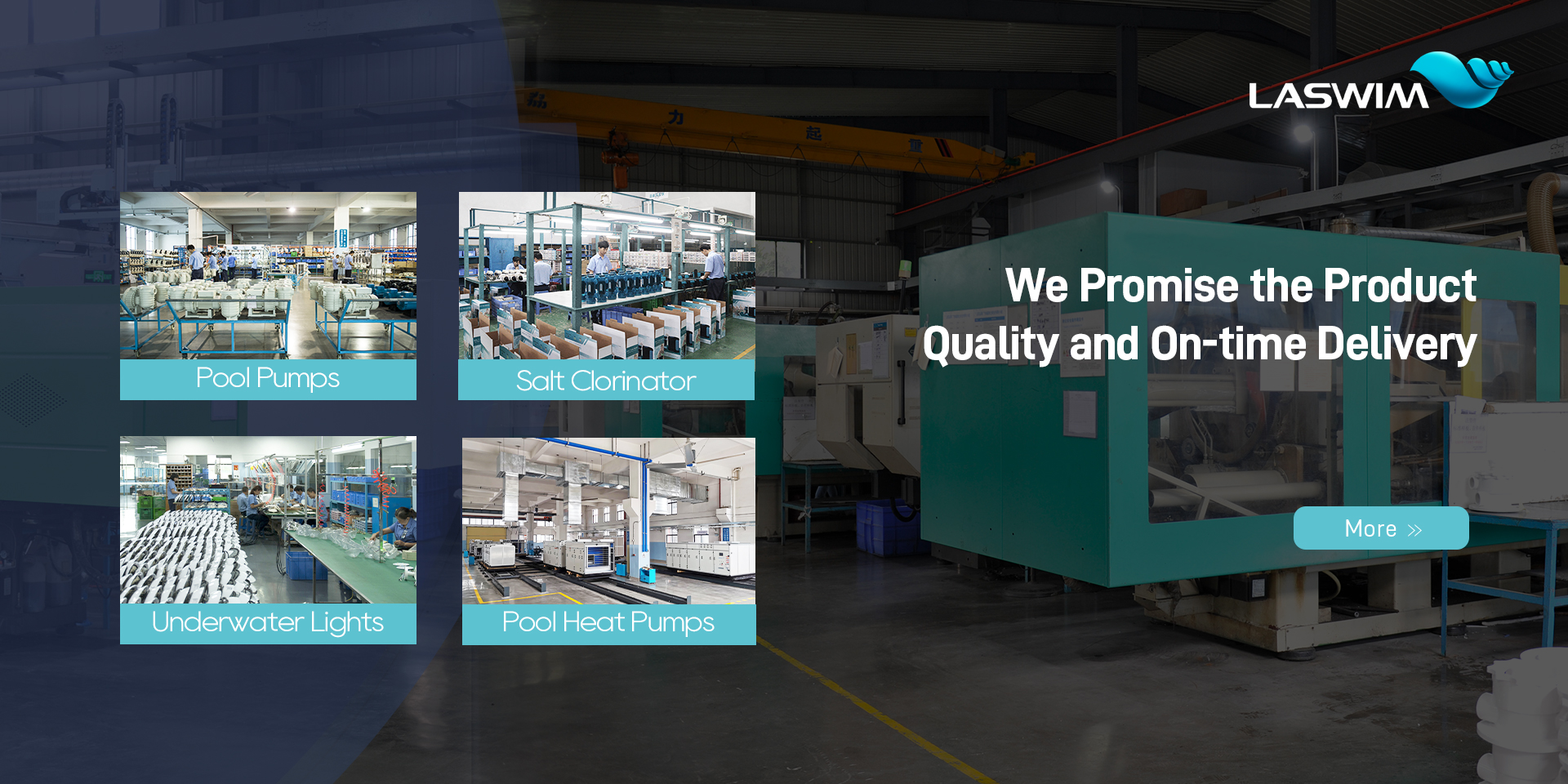
For pumps specifically, verification covers motor endurance testing, hydraulic performance testing, component lifecycle verification and 100% operational inspection of finished units. The failure modes these checks target are the ones that matter in the field — dry running, motor overheating, seal leakage, hydraulic overload and vibration damage — and they are controlled through dry-run protection, temperature protection, pressure monitoring, variable-speed control and a reinforced sealing structure.
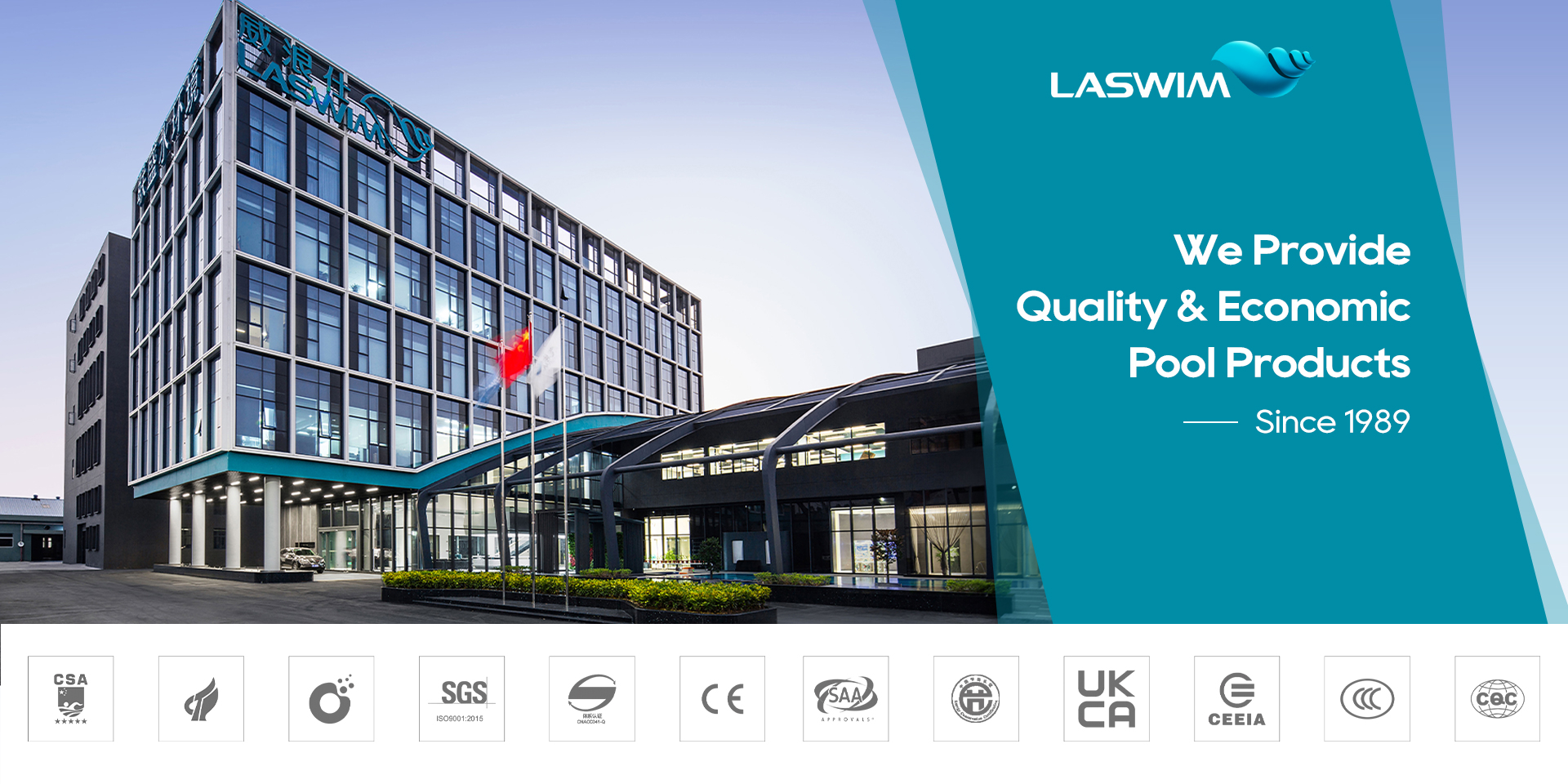
Because pump selection depends on the whole circuit, matching is easier when the pump, filter, heat pump and disinfection equipment come from one supplier: flow windows, connection sizes and control logic are already coordinated. The full product range and published specifications are available at www.laswimaqua.com.
Frequently Asked Questions
What safety standard applies to swimming pool pumps, and what should buyers verify?
Electric pumps for household use are covered by IEC 60335-2-41:2024, published by the International Electrotechnical Commission. For a pump purchase, this means buyers should confirm the declared standard compliance, the electrical rating of the motor, and the protection class of the installation. LASWIM Water Environment Equipment Co., Ltd. manufactures its pump range under ISO 9001 quality management, and pump verification includes motor endurance testing, hydraulic performance testing, component lifecycle verification and 100% operational inspection of finished units.
Should I choose a 0.33 HP or a 1.2 HP inverter pump for a residential pool?
Power is the ceiling of the performance curve, not a measure of quality. Calculate the flow you need by dividing pool volume by your planned daily run time, estimate total head including the filter, heat exchanger and salt cell, and then choose the lowest output power inside the 0.33 HP to 1.2 HP band that still covers that duty point. The LASWIM WL-ESP and WL-HV2100-200 series cover this range with 11–19 m³/h maximum flow, 9 m or more of maximum head and a 1000–3200 RPM speed range. For larger pools, LASWIM's bigger variable-speed models reach 31–40 m³/h and 16.9–20 m.
How much does an inverter pump reduce running costs compared with a single-speed pump?
On LASWIM's residential inverter pump platform, variable speed control and an IE4 high-efficiency motor reduce energy consumption by up to 90% compared with traditional single-speed pumps. Annual energy saving reaches up to 12,614 kWh based on a 2 HP continuous operation reference, and total ownership cost is reduced by approximately 30–50% over 3 to 5 years. Maintenance frequency is also approximately 30–40% lower than standard pumps.
Can buyers review technical documentation or arrange a sample before ordering?
Yes. Buyers comparing the WL-ESP and WL-HV2100-200 series for a residential or hotel project can request specifications, curve data and sample arrangements directly from LASWIM — email laswimpoolwater@gmail.com or message +86 18022011329 on WhatsApp — and check the pump's flow and head against the project's hydraulic calculation before placing an order.
What determines lead time and delivery planning for a pool pump order?
Lead time depends on the model, configuration, order quantity and destination market. LASWIM manufactures in a 90,000 m² facility with 630 employees and 53 R&D engineers, and has an annual output capacity of 2,400,000 units, with about 70% of production exported to North America, South America, Europe, Southeast Asia/Mideast, Africa, East Asia (Japan/South Korea) and Australia. Buyers planning a residential or commercial project should confirm the current production schedule with the LASWIM sales team when they place the enquiry, and can review the full range in the LASWIM Commercial & Residential Swimming Pool Equipment Catalog.
Conclusion
The three parameters in this guide are the whole decision. Output power sets the ceiling of the performance curve, maximum flow rate sets turnover capacity and compatibility with the rest of the circuit, and maximum head decides whether the pump can push water through your particular installation at all. For a residential pool, an inverter pump from 0.33 HP to 1.2 HP with 11–19 m³/h maximum flow, 9 metres or more of maximum head and a 1000–3200 RPM speed range covers the great majority of layouts — provided the duty point is checked against the real system rather than assumed from pool volume.
Buyers who calculate flow and head first, and then choose the lowest power that covers the duty point, capture the energy and maintenance advantages that variable-speed control makes possible. Buyers who skip that step usually pay for the omission twice: once in the pump, and again in operation.

Match the Pump to the Pool, Not the Label
Send LASWIM your pool volume, planned daily run time and system layout, and the team will help you confirm the flow and head duty point before you order. Email laswimpoolwater@gmail.com or WhatsApp +86 18022011329.
Full specifications for pumps, filters, heat pumps, salt chlorinators and disinfection systems are in the LASWIM Commercial & Residential Swimming Pool Equipment Catalog.
Have Questions or Need More Details?
Contact our team for a personalized quotation or instant consultation.
Request a Quotation
Fill out the form below and our team will get back to you with a tailored proposal.
WhatsApp Direct Chat
Prefer to chat in real-time? Message us on WhatsApp for instant assistance & quick answers.
- Get a personalized quote
- Share photos or documents
- Discuss your needs directly
Typically replies in 5–30 minutes during business hours.