
Swimming Pool Equipment Compliance Guide: Regional Standards, Voltage & IP
Swimming Pool Equipment Compliance Guide: Regional Standards, Voltage & IP
A swimming pool equipment compliance check is a documentation exercise, not a marketing claim. For any pool light, pump, salt chlorinator, filter, heat pump or disinfection system, a buyer needs five verifiable data points: rated voltage and frequency, enclosure (IP) rating, electrical safety class, motor efficiency class where a motor is involved, and the material or refrigerant declaration that applies to the destination market.
Everything else — “CE certified”, “export standard”, “European quality” — stays unverifiable until a document appears with a certificate number, a model scope and an issuing laboratory. This guide shows buyers at the evaluation stage how to turn regional market requirements into concrete specs they can compare, audit and file.
Problem Definition: Four Mismatches That Decide Whether an Order Clears
A supplier can hold completely valid documentation and still fail a buyer’s compliance review, because the failure is almost never in the certificate itself. It is in the match between the certificate and the specific order. Four mismatch types cover most cases.
1. Scope mismatch
The document is genuine, but the model list inside it is not the model in the quotation. A Certificate of Compliance numbered FCS202512152E01, for example, lists a scope of PE20C, PE20S and PE20CS. If a purchase order specifies a different light model, that particular certificate does not cover it, no matter how official the PDF looks.
2. Standard mismatch
Different standards prove different things. An EMC test report against EN IEC 55015 and EN IEC 61547 demonstrates electromagnetic compatibility. It does not demonstrate electrical safety. Electrical safety is addressed by a different standard family — EN 60335-1 and EN IEC 60335-2-41 for pumps, EN IEC 60335-2-40 for heat pumps. A buyer who accepts an EMC report as proof of electrical safety is holding the wrong document.
3. Rating mismatch
IP68, IPX5 and IP55 are not interchangeable, and the letter X is not decoration. IP68 means the enclosure is rated for continuous immersion. IPX5 means protection against water jets, with dust ingress unrated. IP55 means limited dust ingress and protection against water jets at lower pressure than IPX5. Applying an IP68 assumption to a pump because the supplier also sells IP68 lights is a common and expensive error.
4. Date and expiry mismatch
Documents age at different rates. Most LASWIM test reports and certificates on file carry a recorded expiry of 2099-12-31, which functions as an internal placeholder rather than a real review date and should be confirmed with the factory. At least one document behaves differently: Certificate of Compliance TST20240702072-1SC, covering the SR50–SR300 scope against EN 60335-1 and EN 62233, shows an expiry of 2028-07-21. Buyers who archive by issue date and ignore expiry will eventually ship against a lapsed file.
Evaluation-stage rule: never accept a compliance statement at product-family level. Accept it only at model level, with a standard number, a laboratory name and an issue date attached.
Industry Background: Why Compliance Requirements Are Tightening
Pool equipment compliance is becoming a volume problem, not a niche problem. The global swimming pool equipment market was estimated at USD 14.22 billion in 2025 and is projected to reach USD 21.33 billion by 2033, according to Market Research Future. China was the leading exporter of sports and pool equipment in 2024 with a trade value of approximately USD 3.77 billion, according to the Observatory of Economic Complexity.
Two product categories are expanding faster than the certification capacity of many suppliers. The global pool heat pump market was valued at USD 5.09 billion in 2024, with North America holding a 34% share, according to Straits Research. The salt chlorine generator market for swimming pools was valued at USD 1.45 billion in 2024, with approximately 58% of new suburban residential pools opting for saltwater systems, according to Arizton Advisory & Intelligence. The global regenerative media filter market, used in advanced pool filtration, was valued at USD 1.12 billion in 2025 with a CAGR of 6.8%, according to Dataintelo.
On the standards side, pool pumps for liquids are subject to safety standard IEC 60335-2-41:2024, which covers electric pumps for household use, per the International Electrotechnical Commission. Since pumps, chlorinators and heat pumps are sold into grids with different voltages, frequencies and approval regimes, the document set travelling with a container matters as much as the hardware inside it.
LASWIM Water Environment Equipment Co., Ltd. is a Chinese pool and spa equipment manufacturer founded in 1989, operating a 90,000 m² facility with 630 employees, 53 engineers and an annual output of 2,400,000 units. Roughly 70% of output is exported across North America, South America, Europe, Southeast Asia and the Middle East, Africa, East Asia and Australia — which is precisely why its product documentation must answer to several regulatory systems at once.

The Detailed Solution: Five Specification Layers Buyers Can Verify
A regional compliance requirement only becomes useful when it is translated into a specification value that either matches the destination grid or does not. Five layers do that translation.
Layer 1 — Voltage and Frequency Compatibility
Voltage and frequency are the first filter, because a mismatched nameplate is not a paperwork problem; it is a hardware problem. LASWIM’s documented supply ratings split into two groups.
The salt chlorinator range is wide-input. The EC Ultra X series — models EC Ultra X-V15, V20, V25, V30, V40 and V50 — is rated AC 100–240 V, 50/60 Hz, with chlorine production from 12 g/h to 40 g/h, maximum pool volumes from 15,000 gal / 60 m³ to 50,000 gal / 200 m³, maximum input current from 2 A to 6 A, and maximum power from 66 W to 290 W. Recommended salinity is 2700–4500 ppm, water hardness below 300 ppm, water temperature 10–45 °C / 50–113 °F, ambient temperature below 50 °C / 122 °F, ambient humidity at or below 90% RH. Pipe connections are 2 in / 63 mm and maximum working pressure is 2.5 bar. The WL-EC Plus 8–30 salt chlorinator is likewise rated AC 100–240 V, covering 8–30 g/h and pool volumes of 35–127 m³. Wide-input chlorinators travel well because a single SKU can be listed for both 120 V and 230 V markets.
The pump range is narrower. The BVX300 and BVX400 variable-speed pumps are rated 220–240 V, 50/60 Hz, as is the WL-HV2100–200 residential variable-speed pump at 1–2 HP. The HLVSP100QW, HLVSP150QW and HLVSP200QW circulation pumps are rated 220 V, 50/60 Hz. The AOP100–400 advanced oxidation disinfection system is specified at 220 V, single phase, 50 Hz. For a project on a 100–120 V grid, the correct action is not to assume a pump will run; it is to confirm the configuration with the factory before the order is placed. LASWIM lists voltage customization among its available customization options.
Layer 2 — Enclosure and IP Protection
IP ratings define where a product may legally and safely be installed, so they should be read from the datasheet rather than inferred from the product photograph.
Underwater lighting is the immersion category. The PS2025 swimming pool light, and the wider LASWIM underwater light line, is rated IP68 with an operating voltage of 12–24 V, power of 6–24 W, and ABS construction, and is stated to comply with IP68 protection and Class III electrical safety standards.
Pumps sit in the water-jet category, not the immersion category. The BVX300 and BVX400 carry an IPX5 protection rating, which covers protection against water jets but leaves dust ingress unrated. The WL-HV2100–200 residential variable-speed pump carries IP55, which adds limited dust protection. Both values support equipment-room installation; neither supports submerged installation, and buyers comparing datasheets should not treat them as equivalent to the IP68 rating on the lighting line.

Layer 3 — Electrical Safety Class and Motor Efficiency
Two specifications in this layer directly affect what a compliance reviewer will ask for.
The first is safety class. Underwater lights operate at 12–24 V and are documented as Class III, meaning protection relies on supply at extra-low voltage rather than on insulation alone. The EC Ultra X salt chlorinator follows the same design logic on the electrode side, operating on a safe 24 V / 29 V low voltage while the control electronics accept the 100–240 V input. For a public or hotel pool, low-voltage electrode and lighting circuits simplify the safety argument considerably.
The second is motor efficiency class, which is increasingly a specification requirement rather than a preference. The BVX300 and BVX400 pumps use an IE5 permanent magnet motor, with the 3 HP model delivering a maximum flow rate of 45 m³/h, maximum head of 18.5 m, a speed range of 1000–3100 RPM, noise below 65 dB, self-priming up to 3 m and a listed motor efficiency of 90%. The WL-HV2100–200 residential pump spans IE4 for the 1 HP and 1.5 HP variants and IE3 for the 2 HP variant, with a maximum flow rate of 31–40 m³/h, maximum head of 16.9–20 m, a speed range of 1000–3200 RPM and noise of <58 to <64 dB. When a tender specifies an efficiency class, these values must appear on the datasheet, not only in a brochure.
Layer 4 — Refrigerant and Material Declarations
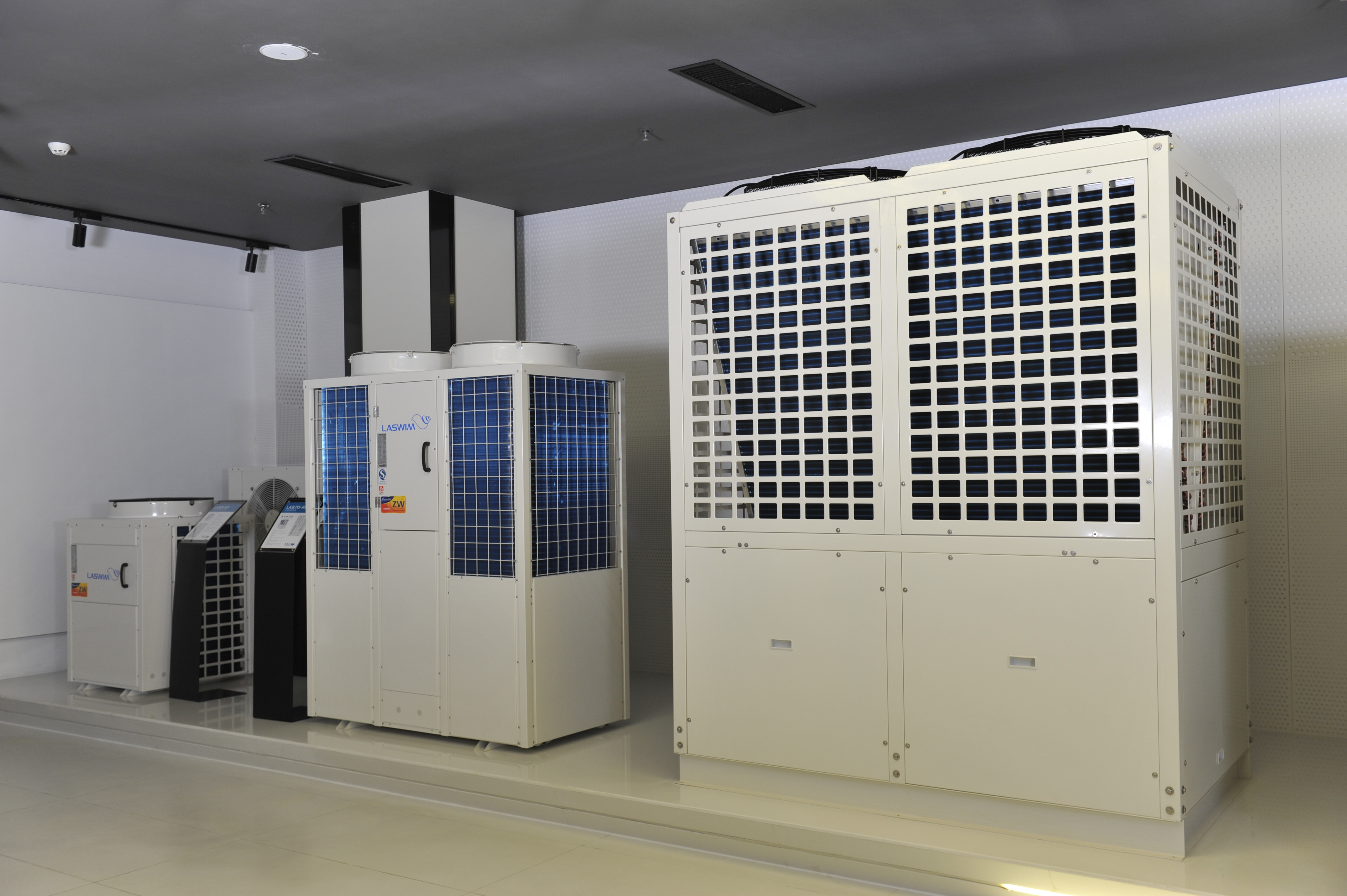
Heat pumps introduce a compliance dimension that pumps and lights do not have: the refrigerant circuit. The LS series of swimming pool heat pumps is documented against IEC 60335-2-40 and EN IEC 60335-2-40 through Test Reports 0824001190, 0824001192, 0824001193 and 0824001194 issued by the Guangzhou Customs District Technology Center, and through the corresponding Certificate of Conformity 0825002970-LVD, which also references EN 60335-1 and EN 62233. Verified data on the LS series lists COPs of 5.8 to 6.4.
Refrigerant type is the question buyers must ask explicitly. R32, R410A and R290 are the common refrigerant families in modern heat pumps, and they are not interchangeable from a regulatory standpoint. Units charged with R290 require different handling, charge-limit and installation-ventilation provisions in many jurisdictions than units charged with R410A. The correct practice is to request the refrigerant type, the charge weight and the applicable declaration for the destination country, then match those documents to local rules before the equipment is specified into a project.
Materials compliance follows the same logic. The WL-EC Plus 8–30 salt chlorinator holds Certificate of Compliance TST20241205841EC for RoHS, issued by Dongguan True Safety Testing Co., Ltd. and referencing the IEC 62321 series of test methods — the restricted-substance evidence that customs and retailer onboarding teams typically request.
Layer 5 — The Document Set Itself
LASWIM’s files show that documentation is issued per model scope by independent laboratories, which is what makes it auditable. A buyer reviewing a pool equipment package can reasonably expect to see:
- Safety / LVD evidence: for example Safety Test Report FCS202310304A01M1 for WL-EC Plus 8–30 against EN 60335-1; Test Report WTF25F01010867J for the WL-BDP200M to WL-BDP400T series against EN 60335-1, EN IEC 60335-2-41 and EN 62233; Test Report WTF25F01010858J for the WL-ESP033M to WL-ESP120M range; and LVD Report TST20250702446SC for the WL-ECP075M to WL-ECP300T range.
- EMC evidence: for example EMC Test Report FCS202510140E01 for the HQ/SQ 20–50 scope against EN IEC 61000-6-1, EN IEC 61000-6-3, EN IEC 61000-3-2, EN 61000-3-3 and immunity tests EN IEC 61000-4-2, -4-3, -4-4, -4-5, -4-6 and -4-11; EMC Test Report WTF25F01010869E for the WL-BDP series; EMC Test Report WTF24F10247373R1E for HLVSP100QW/150QW/200QW; and EMC Test Report WTF25F01010862E for the WL-HV2 100–150 scope.
- Third-party verification: Verification of Compliance GZEM2407004114HSV, issued by SGS-CSTC Standards Technical Services Co., Ltd. for the CS Pro 30 scope against EN 61000-3-3, EN IEC 55014-1, EN IEC 55014-2 and EN IEC 61000-3-2.
- Materials declarations: RoHS certificate TST20241205841EC covering the IEC 62321 series.
- Machinery safety documentation: CE Test Report 0704TST20250700440CE, issued by Dongguan True Safety Testing Co., Ltd. for the WL-HPF80 to WL-HPF380 regenerative media filtration range against EN ISO 12100 and EN 60204-1 — the mechanical-side counterpart to an LVD report.
LASWIM states a commitment to ISO 9001 quality certification and applies 100% inspection covering both function and visual checks, which supports the traceability that compliance files depend on.

Step-by-Step Breakdown: How to Run a Compliance Review on Pool Equipment
The following six steps convert a destination market into a checkable document list. They are written for a buyer evaluating a first or second order, and they work equally well for an annual supplier audit.
Step 1 — Write the market spec before the request for quotation
Record grid voltage and frequency, installation location (immersed, splash zone or equipment room), whether the site is residential, commercial or public, and whether the operator requires low-voltage circuits. This is the brief the supplier must answer against, and it prevents later disputes about which IP rating was implied.
Step 2 — Match every document to an exact model scope
Read the scope line, not the cover page. If the quotation lists six chlorinator models and the certificate scope lists three, request the remaining three. Scope lists such as PE20C, PE20S and PE20CS or WL-BDP200M through WL-BDP400T are the only reliable indicator of coverage.
Step 3 — Check the standard against the risk you are managing
Safety and compatibility are separate questions. Use EN 60335-1 and EN IEC 60335-2-41 evidence for pump safety, EN IEC 60335-2-40 for heat pumps, EN IEC 55015 and EN IEC 61547 for lighting EMC, and EN ISO 12100 with EN 60204-1 where a filtration skid has moving or automated parts.
Step 4 — Verify the issuing laboratory and the issue date
Laboratory names such as Guangzhou Customs District Technology Center, Dongguan Funas Testing Technology Co., Ltd., Dongguan True Safety Testing Co., Ltd., Waltek Testing Group (Foshan) Co., Ltd. and SGS-CSTC Standards Technical Services Co., Ltd. should appear on the document itself, together with an issue date. Documents dated to 2024 and 2025 remain valid evidence of the testing performed at that time; they are not confirmation of a current production batch, which is why Step 5 exists.
Step 5 — Track expiry and re-issue cycles
Build a simple register with four columns: model scope, certificate number, standard, expiry. Where an expiry reads 2099-12-31, treat it as a placeholder and ask the factory for the review cycle. Where a real date appears — as with TST20240702072-1SC at 2028-07-21 — flag it for renewal well before it lapses.
Step 6 — Freeze the nameplate before production
Once voltage, frequency, IP rating, efficiency class and refrigerant are confirmed, put them in the purchase order as controlled values. Nameplate accuracy is itself a compliance issue, and the cheapest place to correct it is before tooling, not after the container arrives.

Use Cases: What Compliance Looks Like in Real Projects
Compliance work becomes concrete when it is tied to a delivered project. In the European Union, LASWIM equipment has been used across residential villa pool circulation systems in Italy, Greece and Portugal, where quiet performance, high-efficiency motor design and ease of installation were the stated highlights. The project addressed high energy consumption in private villa pools and delivered a 25% reduction in energy consumption as a return on investment — a result that depends on the IE-class motor specification being matched to the actual circulation duty.
In Latin America, distribution and pool-building partners in Brazil, Chile, Colombia and Mexico integrated more than ten residential pool systems, with projects described as showing stable performance under high temperature and a 20% reduction in maintenance cost. Environmental adaptability and material durability were the noted strengths, which is the practical face of an IP and materials specification holding up in a hot, humid climate.
In EMEA, projects across Spain, France and the US covering 300+ pool systems for residential and small commercial applications achieved stable water quality compliance, 30% energy saving and reduced maintenance frequency, with strong system compatibility with existing pool infrastructure and reliable OEM support. In the Middle East and Southeast Asia — Saudi Arabia, UAE, Thailand and Indonesia — public aquatic center water treatment systems serving facilities above 5,000 m² achieved high-efficiency filtration, stable water quality and a 30% reduction in chemical usage over 3–5 year programmes, supported by large-scale system integration and engineering support.
The pattern is consistent: the projects that scale are the ones where voltage, enclosure rating and documentation matched the site from the first specification meeting.
Comparison Table: Compliance-Relevant Specifications by Product Family
The table below compares only specifications that LASWIM has documented. Where a value is not documented for a family, the cell is left empty rather than estimated.
| Product family | Rated power supply | Enclosure / protection | Safety or efficiency class | Standard referenced in documentation |
|---|---|---|---|---|
| Swimming pool underwater light (PS / PE series scope) | 12–24 V, 6–24 W | IP68 | Class III | EN IEC 55015, EN IEC 61547, EN 61000-4-2, EN IEC 61000-4-3 (Certificate FCS202512152E01) |
| Variable-speed pump BVX300 / BVX400 | 220–240 V, 50/60 Hz | IPX5 | IE5 permanent magnet motor; 90% motor efficiency | EN 60335-1, EN IEC 60335-2-41 (pump series documentation) |
| Variable-speed pump WL-HV2100–200 | 220–240 V, 50/60 Hz | IP55 | IE4 (1 HP, 1.5 HP); IE3 (2 HP) | EN 60335-1, EN IEC 60335-2-41, EN 62233 (HV2 100–150 scope) |
| Circulation pump HLVSP100QW / 150QW / 200QW | 220 V, 50/60 Hz | 1–2 HP | EN IEC 55014-1, EN IEC 55014-2, EN IEC 61000-3-2, EN 61000-3-3 (EMC Report WTF24F10247373R1E) | |
| Salt chlorinator WL-EC Plus 8–30 | AC 100–240 V | EN 60335-1 (Safety Test Report FCS202310304A01M1); IEC 62321 series (RoHS TST20241205841EC) | ||
| Salt chlorinator EC Ultra X-V15 to V50 | AC 100–240 V, 50/60 Hz; electrode circuit at 24 V / 29 V low voltage | Low-voltage electrode circuit | Documentation issued per model scope | |
| Heat pump LS series | COP 5.8–6.4 (verified published data) | IEC 60335-2-40, EN IEC 60335-2-40, EN 60335-1, EN 62233 (Test Reports 0824001190 / 1192 / 1193 / 1194; Certificate 0825002970-LVD) | ||
| AOP disinfection system AOP100–400 | 220 V, 1 phase, 50 Hz | EN 61000-3-3, EN IEC 55014-1, EN IEC 55014-2, EN IEC 61000-3-2 (Certificate XTS20240527-E) | ||
| Regenerative media filtration WL-HPF80 to WL-HPF380 | Pump power 7.5–37.0 kW | Filtration accuracy 1–3 µm | EN ISO 12100, EN 60204-1 (CE Test Report 0704TST20250700440CE) |
How to read this table: every entry in the standard column refers to a document whose scope is written against a specific model list. Always re-check the scope line before filing a document against a purchase order. Final certification and labelling rules differ by country, and market entry requirements must be confirmed with local compliance experts.
Frequently Asked Questions
1. Which regional standards apply to swimming pool equipment, and how do I verify them?
Applicable standards depend on the product and the market. For pumps, IEC 60335-2-41:2024 is the relevant household pump safety standard, and LASWIM pump files reference EN 60335-1, EN IEC 60335-2-41 and EN 62233 for electrical safety, with EN IEC 55014-1 and EN IEC 55014-2 for EMC. Heat pumps are documented against IEC 60335-2-40 and EN IEC 60335-2-40. Underwater lights are documented against EN IEC 55015 and EN IEC 61547 for EMC. Verification means reading the certificate number, the scope line, the issuing laboratory and the issue date on the document itself, not the product page. Laswim supplies these documents per model scope, and buyers should confirm final labelling rules with local compliance experts.
2. Can LASWIM supply pool equipment for a specific grid voltage and frequency?
Yes, for the ranges where that is documented. The EC Ultra X salt chlorinator series and the WL-EC Plus 8–30 are rated AC 100–240 V, 50/60 Hz, covering both 120 V and 230 V markets with one platform. The BVX300/BVX400 and WL-HV2100–200 variable-speed pumps are rated 220–240 V, 50/60 Hz, and the HLVSP100QW/150QW/200QW pumps are rated 220 V, 50/60 Hz. For a 100–120 V pump requirement, confirm the configuration with the factory before ordering. LASWIM lists voltage customization among its customization options and offers OEM and ODM service.
3. What drives cost in a compliant swimming pool equipment order?
Cost in a compliant order is driven mainly by the specification level rather than by the documentation itself: efficiency class, enclosure rating, control electronics and the amount of customization requested. LASWIM lists a minimum order quantity of 1 set and flexible customization from samples, designs, minor changes or full customization, so a project can start with a smaller, precisely specified order. Because pricing depends on configuration, the practical approach is to fix the specification first — voltage, frequency, IP rating, efficiency class and refrigerant — and then request a quote against that fixed brief.
4. Can I request samples and compliance documents before placing a bulk order?
Sampling and documentation review belong in the same evaluation step. LASWIM offers OEM and ODM service, a minimum order quantity of 1 set and flexible customization, which means a buyer can validate a specific model before scaling. Request the sample together with the model-scope documents for that same model — for example the LVD or safety report, the EMC report and the RoHS certificate — so that the physical unit and the paperwork are assessed against each other. Quality control is stated as 100% inspection covering both function and visual checks.
5. What is the lead time, and does documentation change it?
LASWIM lists both peak-season and off-season lead time as within 15 workdays, with a one-month window for larger programme orders, supported by a monthly capacity of 200,000 sets. Documentation itself does not usually extend production time, but late specification changes do — which is why the nameplate values should be frozen at order stage. To move forward, request a quote against a fixed specification, download the LASWIM Commercial & Residential Swimming Pool Equipment Catalog, or contact the export team at laswimpoolwater@gmail.com for model-level compliance documents.
Conclusion: Compliance Is a Spec Match, Not a Claim
For a buyer evaluating swimming pool equipment, regional compliance resolves into a short, unglamorous checklist. Confirm the rated voltage and frequency against the destination grid. Read the IP rating literally, and never treat IPX5 as a substitute for IP68. Record the electrical safety class, especially where low-voltage lighting or electrode circuits apply, and record the motor efficiency class where the tender specifies one. Ask which refrigerant is charged and match the declaration to local rules. Then check each document for scope, standard number, issuing laboratory and expiry before it is filed.
LASWIM documents its ranges through independent laboratories including Guangzhou Customs District Technology Center, Dongguan Funas Testing Technology Co., Ltd., Dongguan True Safety Testing Co., Ltd., Waltek Testing Group (Foshan) Co., Ltd. and SGS-CSTC Standards Technical Services Co., Ltd. Buyers who compare documents at that level, rather than comparing marketing language, are the ones who get through customs and commissioning without a compliance surprise. Final certification and labelling requirements still vary by country, so confirm them with local compliance experts before the order ships.
Next Step: Verify the Specs That Matter for Your Market
Send your destination country, grid voltage and installation type, and the LASWIM export team will return the matching model scope, the applicable test report numbers and a configuration-specific quotation. Samples and OEM/ODM arrangements can be reviewed in the same round.
Email: laswimpoolwater@gmail.com | Tel / WhatsApp: +86 18022011329 | Web: www.laswimaqua.com
Download the Commercial & Residential Swimming Pool Equipment Catalog
LASWIM Water Environment Equipment Co., Ltd. — No. 16 Jianye Road, Shenghui South Industrial Zone, Nantou Town, Zhongshan City, Guangdong Province, China. Founded 1989. Contact: Sorcha.
Have Questions or Need More Details?
Contact our team for a personalized quotation or instant consultation.
Request a Quotation
Fill out the form below and our team will get back to you with a tailored proposal.
WhatsApp Direct Chat
Prefer to chat in real-time? Message us on WhatsApp for instant assistance & quick answers.
- Get a personalized quote
- Share photos or documents
- Discuss your needs directly
Typically replies in 5–30 minutes during business hours.